
Gateway/Guides/Water damage timeline
Water damage timeline:
hour one to day fourteen.
A clear, plain-English walkthrough of what happens during a water damage job, from the panicked first call through the insurance handoff. Written so you know what to expect at each stage, and so you can spot anyone who tries to push something that doesn’t belong on the timeline.
In this guide
The full water damage timeline,
hour one to day fourteen
Chapter 01
Hour 0–1
The first call
What to do in the first
hour of water damage
The first hour is mostly about not making it worse. Your only real jobs in that window are: stop the source if you can do it safely, get electricity off in the affected area, and call a real restoration company. That’s it.
Don’t start tearing out drywall. Don’t move soaked furniture across dry rooms. Don’t run the dehumidifier you got at Home Depot, it’s not big enough and you’ll just buy yourself a slow-drying job.
When you call us, we ask three things: what kind of water (clean, gray, or contaminated?), how big an area is affected, and is the source still active. Based on that, we dispatch the right truck with the right equipment.
- Stop the source, shut off water main if a pipe burst
- Cut power to the affected area at the breaker
- Move people and pets out of standing water
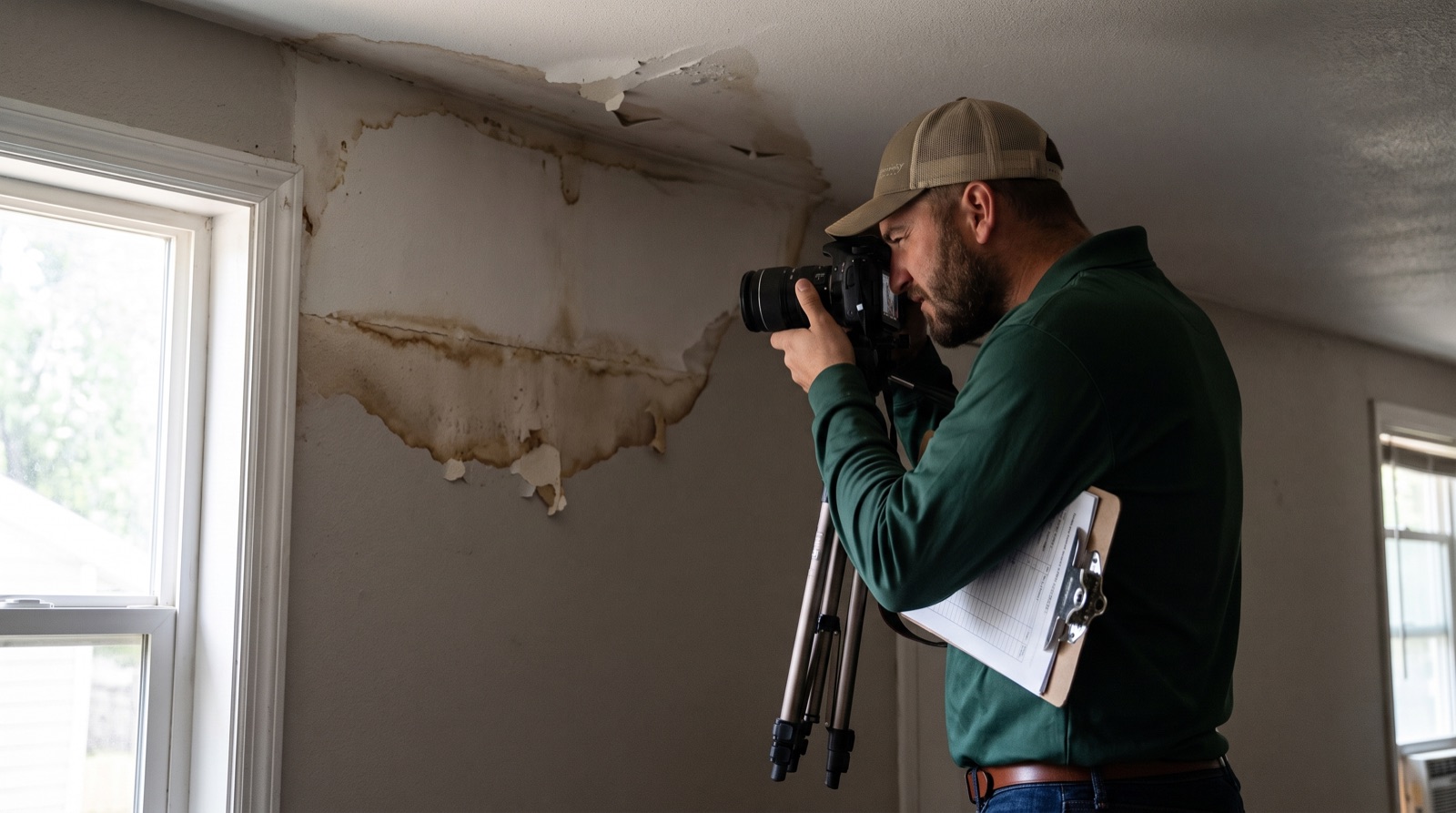
- Take photos with your phone, they help the insurance file later
- Call us. Don’t call your insurance first; let us assess and document, then we both call together
For standing water at a local property, see emergency water extraction in Ballwin or emergency water extraction in Wildwood.
Chapter 02
Day 1
Arrival & assessment
What do the first four hours
of water damage look like?
We arrive fast. Drop cloths come out before equipment does. Every visible material gets photographed before anything is touched. Then we start moisture-mapping with a meter, you’ll see us walking the affected area systematically, marking readings.
Once we know what’s wet and how wet, we start extraction: standing water comes out first with a truck-mounted vacuum, then water trapped in pad and subfloor with specialized weighted extraction tools. By hour four, the room looks dramatically different, most of the visible water is gone and equipment is going down.
If a contractor doesn’t take baseline moisture readings before they start tearing out, walk them out the door. The readings are how the insurance carrier validates the scope.
Chapter 03
Day 2–3
Active drying
How long does drying equipment
run after water damage?
Air movers and dehumidifiers run continuously for 48–96 hours, depending on saturation. Your house will be loud, the affected room may be 80°F+, and there’s nothing wrong with that, that’s the equipment doing its job. Don’t unplug anything to cut down on noise.
We come back daily, take new moisture readings, log them, and adjust equipment placement. The numbers come down a little each day. When materials hit equilibrium moisture (typically 16% or less in drywall, 12% or less in wood), the active drying phase ends.
- Daily monitoring visit (usually 20–30 min)
- New readings logged at every measured point
- Equipment moved or added based on what’s not drying
- Photos updated daily for the insurance file
Chapter 04
Day 4–7
Drying ends, scope finalizes
What gets saved and what gets
thrown out after water damage?
By day five or so, the readings tell us what dried in place and what didn’t. This is where most contractors push to maximize tear-out. We push the other way, if material is dry and structurally sound, it stays. The test is a tool, not an excuse to bill demo.
Anything that has to come out comes out at this point: warped subfloor, swelled cabinets, drywall below the saturation line, contaminated insulation. Everything that came out goes into the insurance file with photos and reasoning.
“Less than you feared” is a real outcome on a lot of jobs. That’s the test doing what it’s supposed to.
Chapter 05
Day 8–14
Insurance + rebuild
Why do water damage claims
stall at the handoff?
The mitigation file goes to your carrier: Xactimate-aligned scope, before/during/after photos, daily moisture logs, equipment counts and run hours, drying records, every line item with a code your adjuster recognizes. Done right, this gets approved without back-and-forth.
From there your rebuild contractor takes over (it can be us if scope warrants, or a separate trusted partner). Reconstruction timing depends on what came out. A small drywall + paint repair might be three days. A full kitchen demo could be three weeks.
- Mitigation file delivered to carrier (digital + hard copy)
- Adjuster review, typically 3–5 business days
- Once approved, rebuild scope finalized
- Reconstruction begins; total timeline depends on what’s being rebuilt
Chapter 06
After
What you should keep
What water damage paperwork should I keep?
Two reasons. First, if mold appears in the next 30–90 days (it shouldn’t, but if scope was missed somewhere it can), you need the moisture readings to prove the carrier should cover remediation. Second, when you sell the home, “fully documented water mitigation event” reads very differently from “DIY repair” on a disclosure.
Keep digital copies of: every moisture reading log, every photo set, the final scope-of-work, the carrier’s approval letter, and any post-job clearance test if one was performed.
When should you call a water damage contractor?
Call a water damage contractor when the water has touched drywall, flooring, insulation, cabinets, trim, subfloor, or more than one room. A towel-and-fan cleanup can handle a small clean spill on a hard surface. It cannot document moisture inside materials, prove the drying timeline, or stop secondary damage once water has moved behind finishes.
Gateway Water & Mold documents the job from the first visit: source of loss, affected rooms, water category, moisture readings, photos, extraction volume when relevant, drying equipment placement, and daily progress. That file matters if the carrier asks whether the damage was sudden, whether mitigation started quickly, and whether mold risk was controlled.
Call before demolition if insurance may be involved
If you may file a claim, do not remove wet drywall, carpet, base trim, cabinets, or flooring before the loss is documented unless there is an immediate safety issue. Start with emergency water extraction and moisture mapping. Then decide what can dry in place, what needs removal, and what belongs in the rebuild scope.
Related reading
Related water damage guides
Emergency water damage restoration in St. Louis
Stop reading. Call us. Live phone, twenty-four seven.
Help with your property
If you need help applying this guidance at your property, see our water damage restoration.
For wet materials that need a drying and repair scope, see water damage restoration in Maryland Heights.