Gateway/Services/Mold remediation
Mold remediation
in St. Louis.
An independent inspector or industrial hygienist collects mold samples; an independent laboratory analyses them. Gateway handles moisture assessment and remediation, using the independent findings to inform the scope.
Most mold gets over-diagnosed and over-remediated. We do the opposite: test the air and the surface, write the scope from the data, and only remove what the readings say has to come out. Honest scope, real plans.
Same operators as AirSense Environmental 145+ five-star AirSense reviews BBB accreditation via AirSense IICRC-trained Gateway crew
For containment, removal and moisture control near your property, explore mold remediation in Clayton, MO or mold remediation in Webster Groves, MO. Each page explains the local service scope and distinguishes independent inspection and laboratory analysis from Gateway remediation.
What’s actually happening
Why suspected mold needs
testing before removal
The thing on your wall might be active mold. It might also be mineral residue from years of dampness, soap scum from a basement utility sink, or a biological staining that’s already dead. An independent inspector determines whether sampling would help establish the scope.
Is surface staining actually mold?
Cosmetic discoloration that looks like mold but isn’t. Mineral residue, smoke, soap scum, or dead biological staining. Doesn’t need remediation, but does need an honest answer.
What active mold growth looks like
Living mold colonies releasing spores. Usually visible as fuzzy or velvety, often with detectable odor. Real remediation work: containment plastic, HEPA negative-air, removal, antimicrobial.
How hidden mold colonies are found
Mold growing behind drywall, in HVAC ducts, in ceiling cavities. Often discovered by smell or during demo of a different scope. Air-quality testing usually catches it before tear-out.
“We won’t tell you it’s mold because it looks like mold. We use independent findings, we plan, and we tell you what you don’t need to remediate.”
Basement mold cleanup after water damage.
Basement mold cleanup starts with the water source, not the stain on the wall. A basement that stayed wet after a sump pump failure, sewer backup, foundation seepage, or appliance leak can hold moisture behind base trim, carpet pad, drywall, insulation, shelving, and stored contents long after the visible water is gone.
Gateway Water & Mold treats basement mold as a moisture-control problem first and a remediation job second. We identify whether the growth is connected to a recent basement flooding event, an unresolved humidity problem, a slow plumbing leak, or contaminated water from a drain or sewer backup. That source affects containment, removal scope, insurance documentation, and whether the basement needs drying work before mold removal begins.
When basement mold needs professional cleanup
- The basement has a musty odor after water extraction or drying.
- Drywall, trim, carpet pad, shelving, or stored contents stayed wet for more than 24 to 48 hours.
- Visible growth is spreading along lower walls, behind furniture, or near the sump pit.
- The water source was a sewer backup, drain backup, or other potentially contaminated loss.
- Someone in the home has asthma, allergies, immune concerns, or recurring irritation in the affected area.
For recent water losses, we coordinate mold remediation with water damage restoration documentation so the file shows the cause, the affected materials, moisture readings, containment setup, removal scope, and clearance path. The goal is not just to remove visible growth. The goal is to prove the basement is dry, clean, and ready for rebuild or safe use.
What’s included
What does mold remediation include?
-
Independent mold air-quality testing and surface sampling
Spore counts on the affected area + an outdoor control sample. The control matters, a high indoor count only means something compared to ambient outdoor.
-
Surface sampling
Tape lift or swab where indicated. Identifies genus and rules out non-mold staining. Lab turnaround typically 2–3 business days.
-
Moisture-source diagnosis
Mold is a moisture problem. We trace the water source, leak, condensation, infiltration, vapor, and document it for the remediation plan and for any reconstruction.
-
Containment + negative air
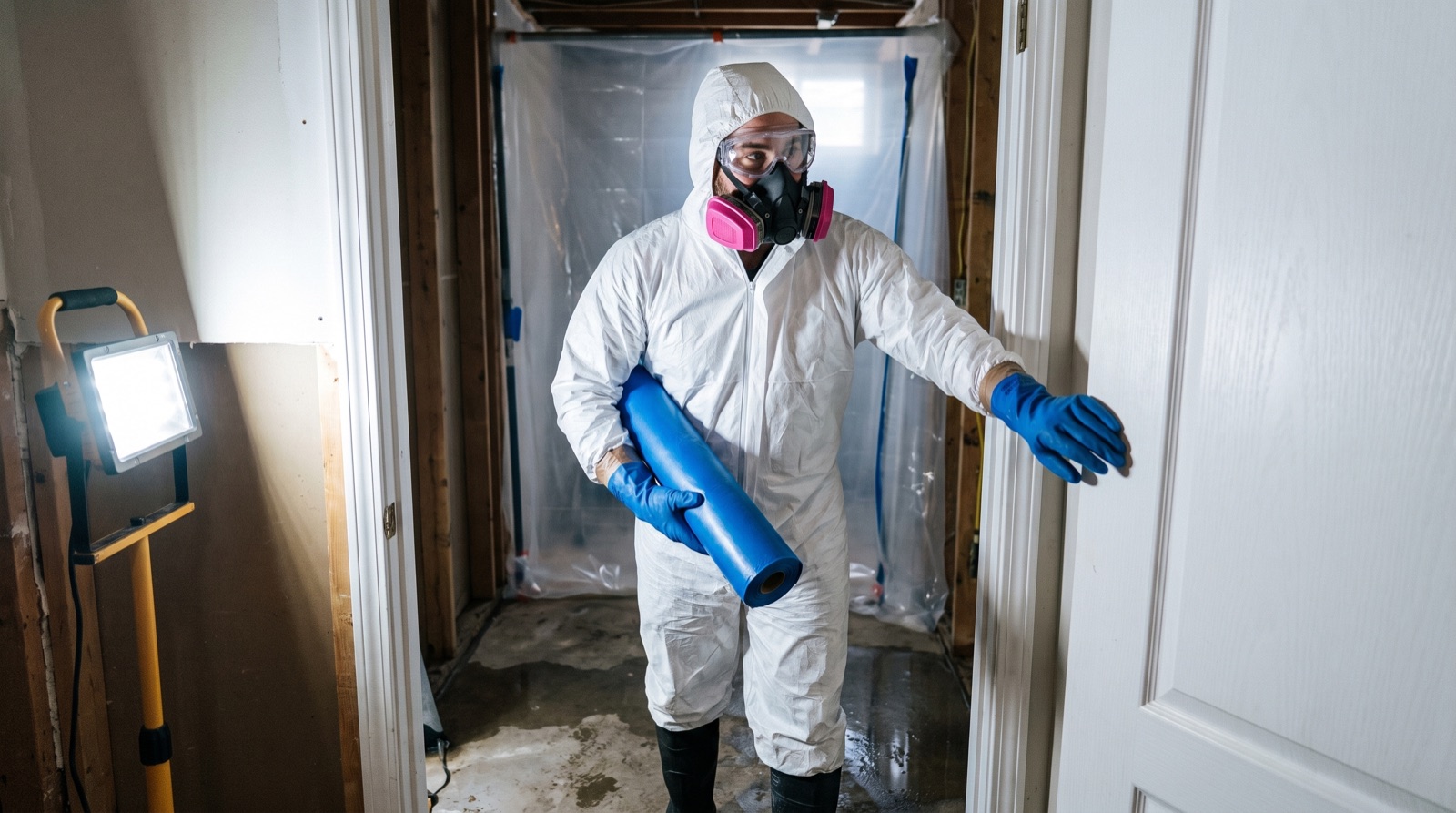
Polyethylene containment of the work area. HEPA-filtered negative-air machines so spore-laden air doesn’t migrate to the rest of the home during removal.
-
PPE-required removal
Full PPE (P100 respirators, Tyvek, gloves). Affected materials cut, bagged, and disposed of inside containment. No spore release into clean spaces.
-
HEPA cleaning + antimicrobial
Surface HEPA vacuum and damp-wipe of every surface inside containment. Antimicrobial applied where it’ll do something, never as performance theater.
-
Clearance air-quality test
Independent post-remediation testing to confirm spore counts have returned to (or below) baseline. We don’t take down containment until the numbers say we can.
-
Final report + photos
Pre, during, and post photos. Lab results. Scope-of-work executed. Clearance test results. The complete file, for you, for insurance, for any future buyer of the home.
How a mold job runs
The four steps of mold remediation
-
01
Mold inspection and air-quality testing
An independent inspector or industrial hygienist collects mold samples; an independent laboratory analyses them. Gateway handles moisture assessment and remediation, using the independent findings to inform the scope.
-
02
Mold remediation scope and approval
Written remediation scope based on the lab results. We walk you through it before any demo. You approve, then we mobilize.
-
03
Step three: mold containment and removal
Containment built. Negative air running. Affected materials removed by PPE-equipped crew. HEPA cleaning of all interior surfaces.
-
04
Mold clearance testing and close-out
Independent clearance air-quality test. Once it passes, containment comes down, final cleaning, full documentation file delivered.
Insurance & mold
How mold coverage works
on a homeowners policy
Most homeowners policies have a mold cap, often $5,000 or $10,000, that’s separate from the underlying water-damage coverage. Whether mold remediation is covered at all depends on the source: sudden water event with prompt mitigation usually yes, slow leak ignored for months usually no.
We’re trained to document the source and the timeline so the carrier has what they need to make a decision quickly. We’ll tell you upfront what’s likely covered and what’s not, including when it’s worth fighting and when it isn’t.
- Source-of-moisture documentation built into every job
- Pre and post air-quality testing for the file
- Photo + scope documentation aligned to carrier expectations
- Direct adjuster communication when you authorize it
Common questions
Mold remediation questions
St. Louis homeowners ask
Do I really need a test, or can you just look at it?
If the affected area is small (under a few square feet), the source is obvious, and visible growth is clearly active, sometimes a visual is enough. For anything larger, anything ambiguous, anything with a health concern, or anything where the homeowner wants documentation, an independent inspector determines whether sampling is useful and collects any samples for independent laboratory analysis. The cost of testing is small compared to the cost of remediating something that wasn’t actually a problem.
How much does a mold inspection cost?
Ask the independent inspector for a written sampling scope and quote, including laboratory fees. Gateway quotes remediation separately.
When can I move back into the room after remediation?
Discuss site-specific re-occupancy requirements with the remediation team. For personal health concerns, consult a qualified healthcare professional.
Will my insurance cover this?
Maybe. Most policies cap mold coverage at a flat amount (commonly $5K–$10K) and require the source to be a covered peril. If the mold was caused by a sudden water event you mitigated promptly, coverage is more likely. If it grew from a slow leak you knew about, less likely. We help you read the relevant policy language.
Is black mold actually dangerous?
“Black mold” is a common name for Stachybotrys chartarum, which is one of many mold species. It’s not the only species that matters, and color alone isn’t a reliable identifier. For questions about personal health effects, consult a qualified healthcare professional. We let the lab tell us, not the color.
Why do you do clearance testing? Other companies don’t.
Because “trust me, it’s gone” isn’t documentation. Independent clearance testing is the difference between hoping the work was complete and proving it. It also matters when you sell the home, a documented clearance is a real asset on the disclosure.
Related services
What else we do.
Mold inspection or remediation: five questions to consider
Use these questions to describe the moisture problem when you call Gateway. An inspection establishes the scope; this guide does not diagnose health conditions.
- Can you see suspected mold, or is there only an unexplained musty odor?
- Where is the affected material, and approximately how much is affected?
- Is a leak, flood, condensation or another moisture source still present?
- Has the problem returned after previous cleaning or drying?
- Do you need an inspection, documentation or a remediation scope before work begins?
Describe what you can see without disturbing affected materials. Call Gateway at (314) 947-3419, 24/7, or learn about mold remediation.
Mold cities served
Where we do mold remediation.
Containment, HEPA, post-remediation verification on every job, every city. Pick your neighborhood for what we typically find there.
Inner Ring
West County
North County
South County
St. Charles County
City of St. Louis
Illinois Riverbend
Metro East
Belleville Cluster
Suspect mold? Don’t guess.
Schedule an inspection. Live phone, twenty-four seven.
Related service information
Read about mold remediation in Clayton, MO and the local property conditions that shape the work.
Read about mold remediation in Chesterfield, MO and the local property conditions that shape the work.
Read about mold remediation in St. Louis City, MO and the local property conditions that shape the work.
Read about mold remediation in Florissant, MO and the local property conditions that shape the work.
Read about mold remediation in Edwardsville, IL and the local property conditions that shape the work.
Read about mold remediation in Belleville, IL and the local property conditions that shape the work.
Check our complete Missouri and Illinois service area for additional communities.
Relevant completed work
Clayton, MO project
- Loss
- Buyer requested mold test on a 1920s home before closing.
- Response
- same day
- Result
- Clear report delivered for the closing file. No remediation needed.
Belleville, IL project
- Loss
- Visible staining in master bath plus persistent musty smell led to air-quality testing that confirmed hidden colonies behind original plaster walls.
- Response
- scheduled
- Result
- Containment, controlled demo, HEPA cleaning, and clearance test, all documented for future sale disclosure.