
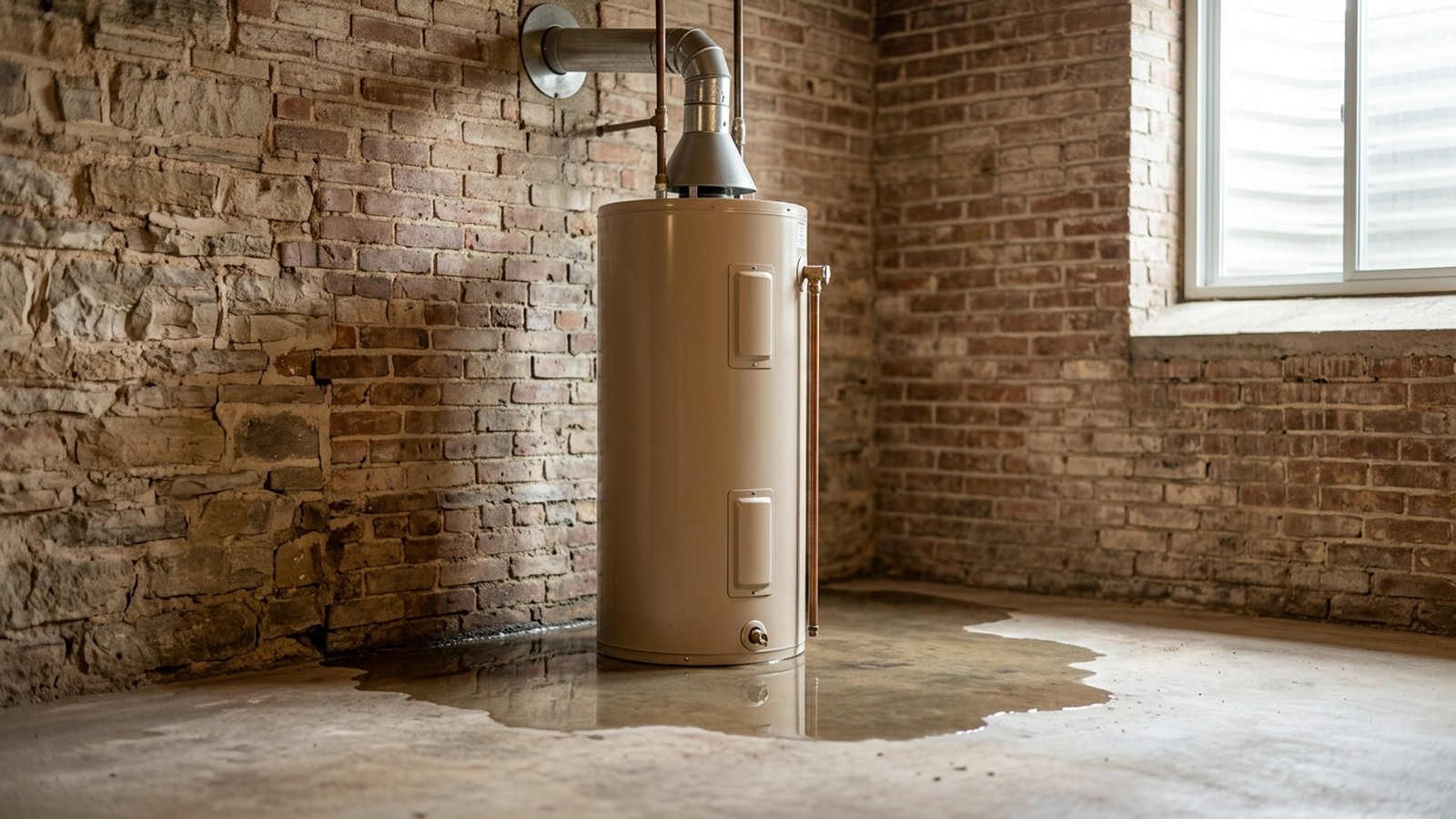
Shut off the power to the water heater first, then the cold water supply valve on top of the tank, and only then start moving water and belongings. A forty- or fifty-gallon tank empties onto a basement floor in minutes, and the order of those first two steps is what keeps a plumbing failure from becoming an electrical hazard.
This guide covers the first hour: how to tell a slow drip from a tank that is about to let go, how to isolate the unit safely on both electric and gas models, what to photograph before anything gets moved, and where the line sits between what a homeowner can dry and what needs extraction and monitored structural drying.
What should you do first when a water heater is leaking?
Kill the energy source, then the water, then deal with the water on the floor. Doing it in that order matters because a basement water heater sits near outlets, a furnace, a sump pump and often a panel, and standing water plus energized equipment is the one combination that turns a cleanup into an injury.
Step 1: Cut power or gas to the heater.
- Electric heater: switch off the double-pole breaker labeled for the water heater at your electrical panel. If the floor around the panel is already wet, do not walk to it. Stay out and call an electrician or your utility.
- Gas heater: turn the gas control dial on the front of the unit to “off” or “pilot,” or close the gas shutoff valve on the supply line running into the unit.
Step 2: Close the cold water supply. There is a valve on the cold inlet pipe at the top of the tank. Turn it clockwise until it stops, or turn the handle perpendicular to the pipe if it is a lever. If that valve will not move or is corroded solid, shut the whole house off at the main.
Step 3: Stay out of standing water near anything electrical. Outlets, cords, the furnace, a chest freezer. If water has reached any of them, treat the area as off-limits until power to that circuit is confirmed off.
Step 4: Photograph before you move anything. Wide shots of the room, the water line on the wall or on boxes, the heater itself, and close shots of anything stored on the floor that got wet. This is the record that does the work later, and our guide on what to document before filing a water damage claim walks through what else belongs in it.
Step 5: Get contents up off the floor. Cardboard, paper, fabric, particleboard furniture and anything stored directly on concrete. Wet cardboard is the fastest route to a mold problem in a St. Louis basement.
Where is the water heater leaking from, and what does it mean?
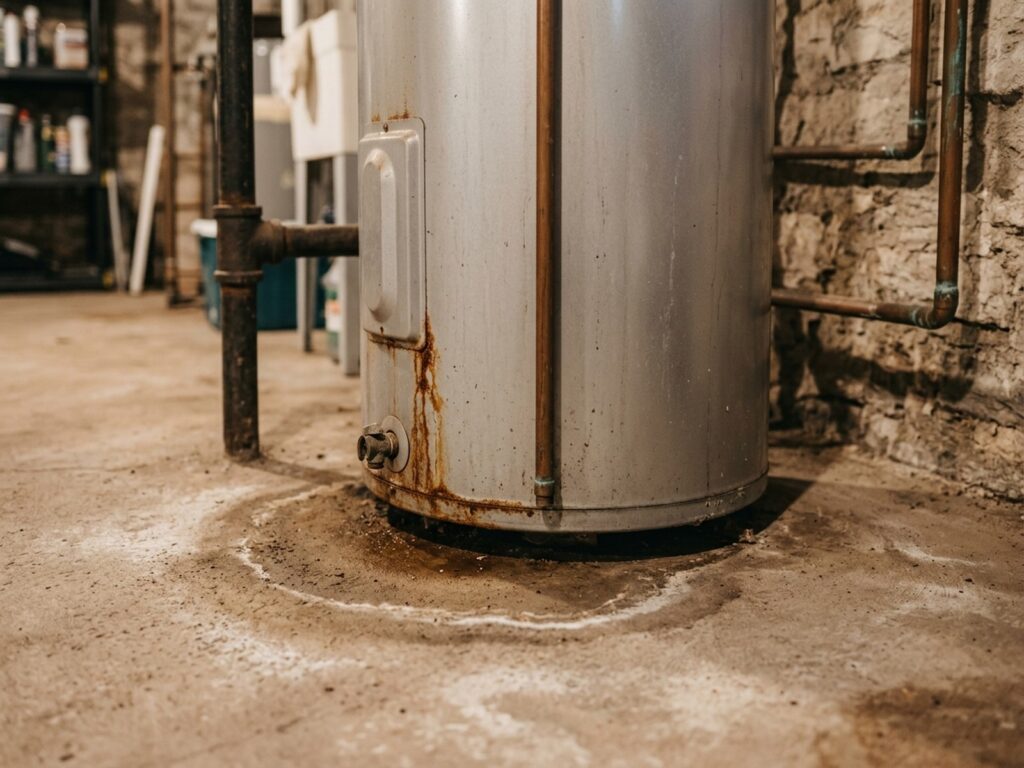
The leak location tells you whether this is a repair or a replacement, and how much time you have. Look before you assume, because water tracks along the floor and the puddle is often nowhere near the source.
| Where the water appears | Likely source | How urgent |
|---|---|---|
| Dripping from a pipe at the top of the tank | Loose or corroded inlet/outlet fitting | Low: repairable, but stop the drip before it stains |
| Running from a discharge pipe near the floor | Temperature and pressure relief valve doing its job, or failing | High: pressure or temperature problem, call a plumber today |
| Seeping from the drain valve at the bottom front | Drain valve washer or a valve left partly open | Low to moderate: often repairable |
| Pooling underneath, from the base of the tank itself | Tank corrosion; the steel has failed | Highest: the tank will not be repaired, and it can open up |
| Wet only around the top, no visible drip | Condensation on a cold inlet in a humid basement | Low: verify before assuming a leak |
Water rising from underneath the tank is the one that ends the conversation. When the inner tank has corroded through, there is no patch. It needs replacing, and until it is replaced it can go from a seep to an open flow without warning.
The relief valve case deserves its own note. That valve is a safety device, and the U.S. Consumer Product Safety Commission’s publication on tap water scalds covers why household water temperature is set where it is. A discharging relief valve is telling you something about pressure or temperature in that tank. Do not cap it, plug it, or screw anything into it. Call a licensed plumber.
How much damage can a water heater leak actually do?
More than the tank holds, because the supply line keeps feeding the leak until somebody closes a valve. That is why a failure that begins at 2 a.m. is a different event from one you walk in on. Slow leaks are their own category of expensive: the EPA notes that the average household’s leaks can account for more than 9,300 gallons of water wasted every year, and a heater weeping quietly behind stored boxes is exactly the kind nobody finds until the drywall darkens.
The part that decides how bad this gets is time. EPA guidance on mold is unambiguous on the window: clean and dry any damp or wet building materials and furnishings within 24–48 hours to prevent mold growth. Concrete looks dry long before the wall cavity behind it is, and finished basements hide moisture inside framing, insulation and the bottom of the drywall where a shop vac never reaches.
Can you dry a water heater leak yourself?
Sometimes, and the deciding factors are how far the water travelled, what it touched, and how long it sat. A small puddle on bare sealed concrete caught within an hour is a mop-and-fan job. Anything that reached carpet, drywall, insulation or the underside of a subfloor is not.
You can usually handle it yourself when all of these are true:
- The water stayed on hard, non-porous floor and did not reach a wall
- The affected area is small and you found it immediately
- Nothing porous was sitting in it: no carpet, pad, cardboard, drywall or insulation
- The space dries visibly within a day with airflow and a dehumidifier
Stop and bring in a restoration contractor when any of these are true:
- Water wicked up into drywall or behind baseboard
- Carpet, pad or subfloor got wet
- The leak ran overnight or you do not know how long it ran
- The basement is finished, or there is insulation in the walls
- There is a musty smell, or you can see staining
- You are planning to file an insurance claim
That last one matters more than people expect. Carriers look at whether the loss was mitigated promptly, and a documented professional response is a stronger record than a memory of running a box fan for a weekend.
What does professional water heater leak cleanup involve?
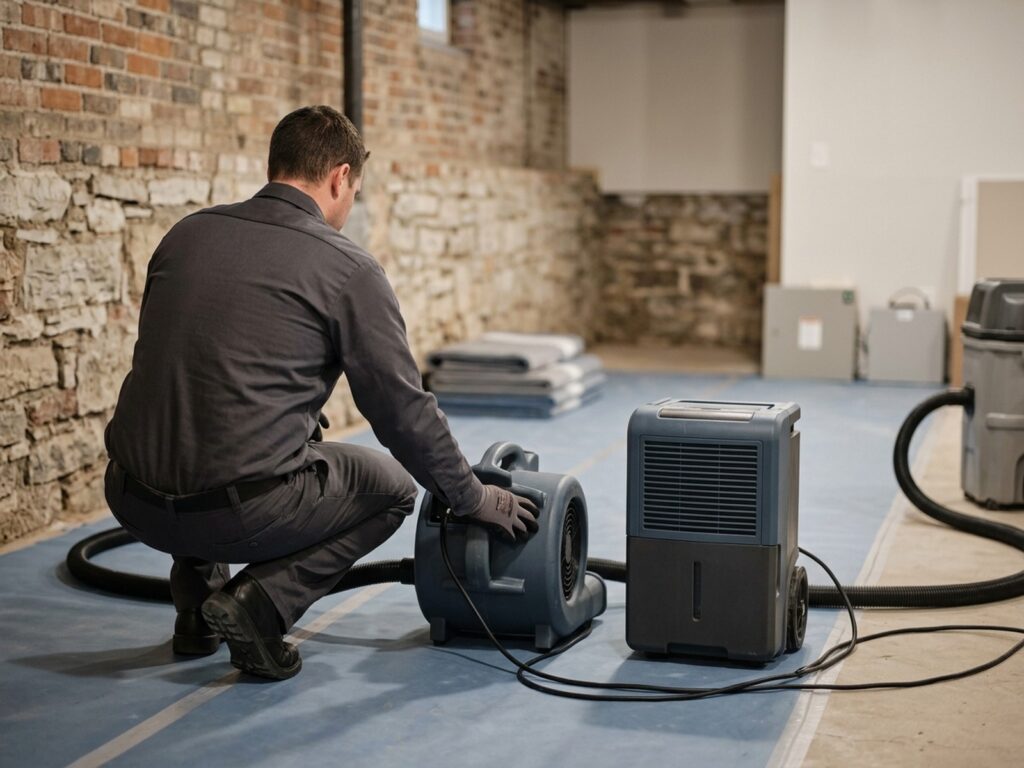
It is a moisture problem, not a water problem, and that distinction drives the whole scope. Gateway’s process is the same one we apply to any Category 1 clean-water loss: assess conditions, document the loss, define the scope, extract, dry, and monitor until the readings say the structure is dry, not until the floor looks dry.
- Assessment and moisture mapping. Meters and thermal imaging establish how far the water travelled inside materials. This is the step that finds water two feet up a wall cavity when the floor stain stopped at six inches.
- Documentation. Conditions, affected materials and readings recorded before anything is moved or removed.
- Extraction. Standing water and water held in carpet and pad removed with extraction equipment rather than absorbed.
- Controlled drying. Air movers and dehumidifiers placed to a plan, with readings taken daily against dry-standard values from unaffected areas.
- Material decisions. Some wet material dries in place; some has to come out. The IICRC’s published standards for water damage restoration are what that call is made against, and our guide to water mitigation versus restoration explains where drying ends and rebuilding begins.
- Verification and handoff. Drying is finished when the readings confirm it, and the file goes to a person for review.
How do you keep this from happening again?
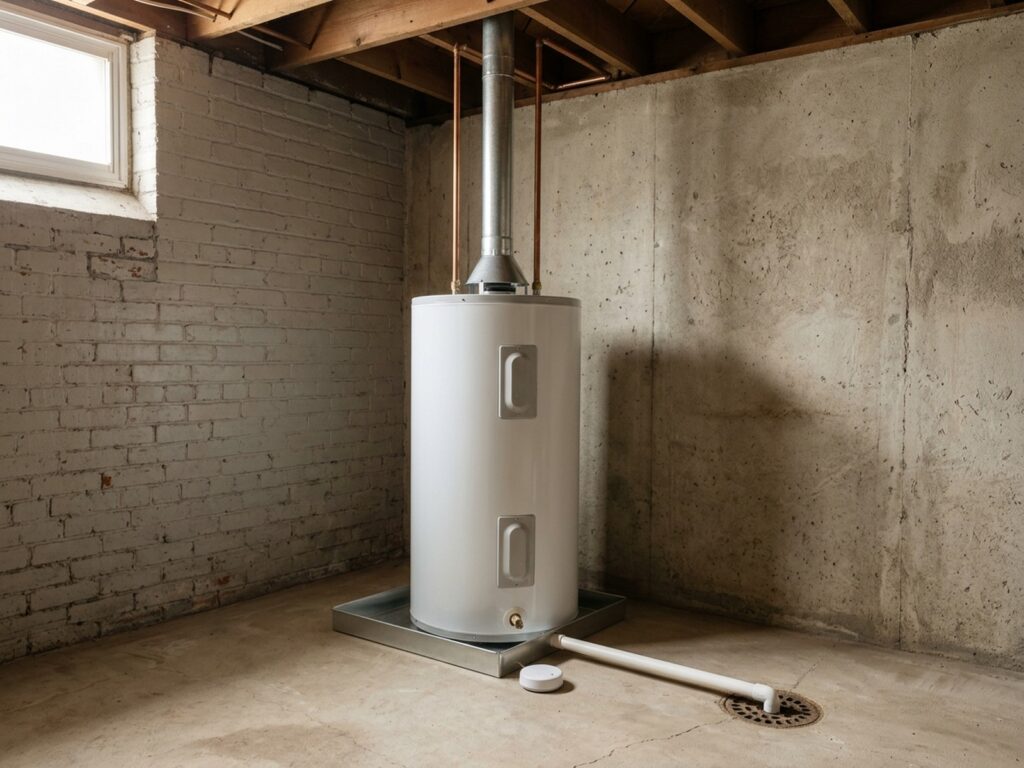
Replace the heater before it fails, and give the next one somewhere to drain. A water heater is one of the few household failures with a reasonably predictable schedule, which makes it one of the few that can be replaced on your terms rather than at 2 a.m.
- Know the age of the unit. The manufacture date is encoded in the serial number on the rating plate; a plumber can read it in seconds.
- Install a drain pan piped to a floor drain. This turns a slow leak into a non-event and is inexpensive at installation time.
- Add a leak sensor. A battery water alarm on the floor beside the tank gives you the hours that matter most.
- Look at it monthly. Rust streaks down the side, dampness at the base, corrosion at the fittings, anything stored against the tank.
- Keep the floor clear. Nothing porous within a few feet of the unit, and nothing stored directly on the concrete.
Frequently asked questions
Is a leaking water heater an emergency?
It depends on where it is leaking from. A drip at a top fitting can wait for a scheduled plumber; water coming from underneath the tank means the tank has corroded through and can open up without warning, and water discharging from the relief valve means a pressure or temperature problem that needs attention the same day.
Should I turn off the water heater if it is leaking?
Yes, and shut off the power or gas before you touch the water valve. Switch the breaker off on an electric unit, or turn the gas control to off on a gas unit, then close the cold water supply valve at the top of the tank.
How long does a water heater last?
Most tank water heaters are replaced somewhere between eight and twelve years, and hard water shortens that. Age alone is not a reason to panic, but a heater past a decade with rust at the base is telling you to plan the replacement rather than wait for it.
Will mold grow after a water heater leak?
It can, and the window is short. EPA guidance is to dry wet materials within 24 to 48 hours. Clean supply water is not itself contaminated, but wet drywall, carpet pad and stored cardboard support mold growth regardless of how clean the water started out.
Does homeowners insurance cover a leaking water heater?
Policies commonly distinguish between sudden accidental discharge and gradual seepage, and the Insurance Information Institute notes that water seepage is excluded under the standard HO-3 policy as a maintenance issue. Your policy and your carrier decide your claim. Document everything and speak to your carrier or agent before assuming either way.
Can I just run a fan and a shop vac?
For a small spill on sealed concrete that you caught immediately, often yes. Once water has reached drywall, insulation, carpet pad or a subfloor, surface drying leaves moisture inside the assembly, and that is where the odor and the mold start.
Get the water out and the structure dry
If a water heater has emptied into your basement, the useful thing to do after shutting it off is to get moisture readings taken before the surfaces look dry and mislead everyone. Gateway Water & Mold provides emergency water extraction and monitored structural drying across the St. Louis metro in Missouri and Illinois, including basement flooding response.
Call (314) 947-3419 to talk through what you are looking at.