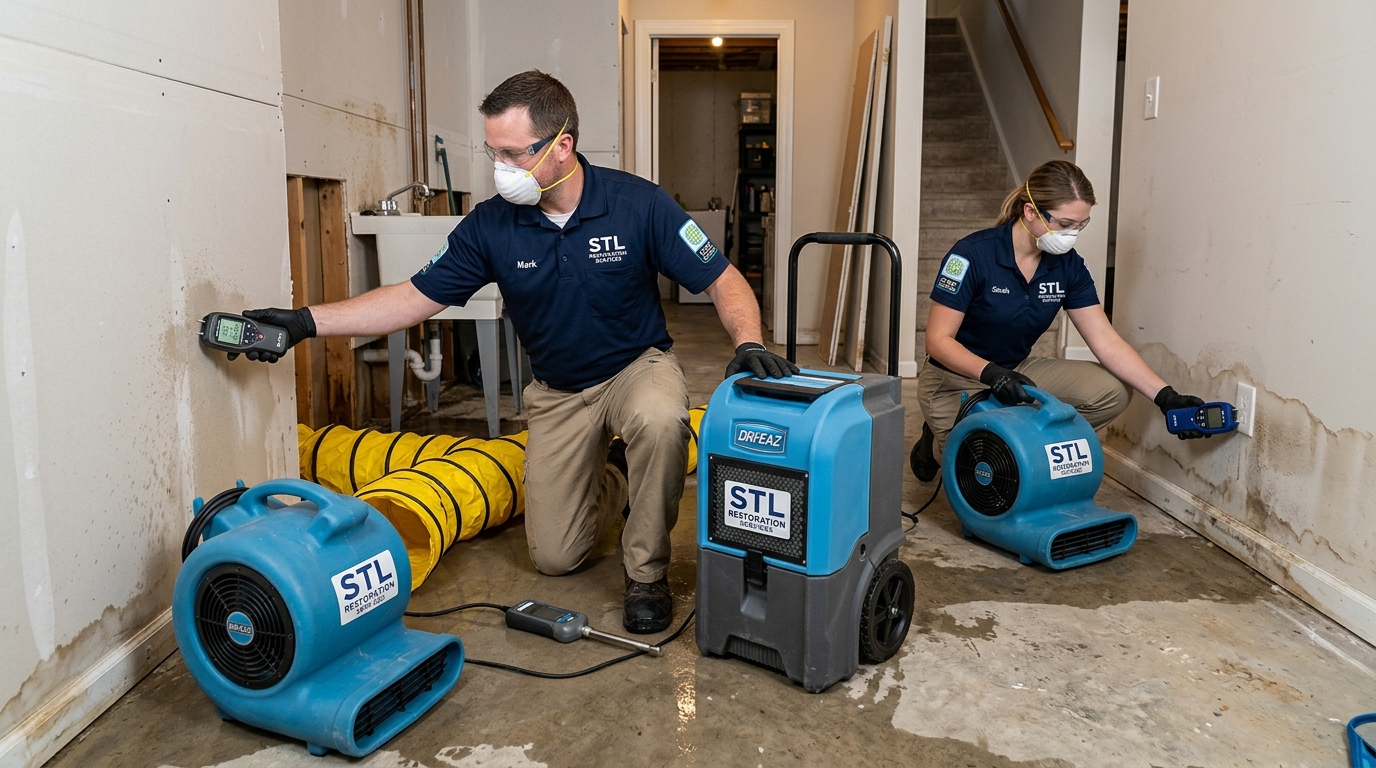
Compare restoration providers using verifiable qualifications, a written scope and actual response availability. No provider choice guarantees a particular property outcome.
Use this guide to compare qualifications, equipment plans, insurance claim assistance and pricing. Confirm details directly with the provider before authorizing work.
Ask how the provider will assess the actual building and damage. Location alone does not establish specialized competence or a health outcome. Ask about water damage restoration services for the actual loss.
What certifications should I look for in a water damage restoration company?
Verify credentials relevant to the proposed work and ask who will perform it. A credential alone does not guarantee a restoration outcome.
Credentials to Verify for the Proposed Scope:
- IICRC credentials: Verify the specific firm’s and technicians’ current credentials rather than assuming all providers hold the same qualification.
- Lead-safe work: Ask the contractor and responsible authority which lead-safe requirements apply to the actual building and proposed work.
- Mold remediation qualifications: Verify relevant experience and credentials; local weather does not establish a fixed mold-growth deadline.
Why It Matters for St. Louis Homeowners:
Ask a restoration company about training, moisture documentation and the proposed drying process. Insurance requirements depend on the policy and loss; an unsupported national claim percentage is not needed to assess a contractor.
Ask how the contractor will assess and document affected materials. Absence of one credential alone does not prove that a provider skips necessary work.
How fast can a water damage restoration company respond to emergencies in St. Louis?
Arrange safe assessment promptly and ask about current response availability. No fixed elapsed time guarantees prevention of damage.
Response Availability to Confirm:
- True 24/7 Emergency Service: Companies with on-call technicians available nights, weekends, and holidays
- On-site arrival: Ask for a current estimate and any written conditions; no universal one-hour industry standard is established here.
- Scheduling: Confirm current availability and safe access for the actual loss.
St. Louis-Specific Considerations:
Ask about actual capacity during widespread storms. No verified regional response-time study or neighborhood flooding comparison is presented here.
Questions to Ask:
- Do you have technicians on-call right now, or do you use an answering service?
- What is your average response time to [your specific St. Louis neighborhood]?
- Can you provide water extraction and drying equipment immediately?
Ask the provider to explain its current dispatch estimate and constraints. A delay alone does not establish poor qualifications.
What equipment and technology should a professional restoration company use?
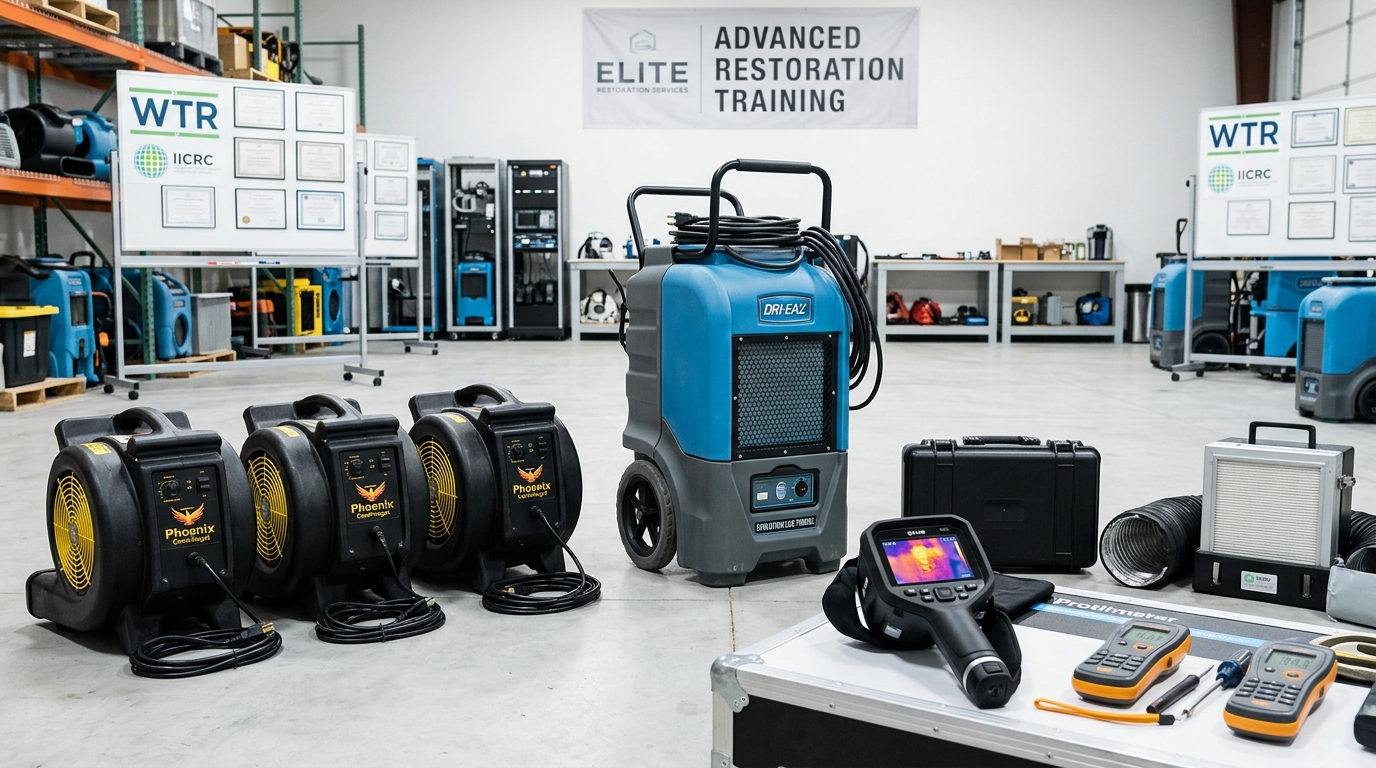
Ask the contractor to explain equipment choices for the actual materials and conditions. Professional equipment does not guarantee shorter drying or prevention of damage.
Equipment Options to Discuss for the Actual Scope:
Water Extraction:
- Extraction equipment appropriate to the loss and site access
- Portable extraction units for multi-story buildings
- Weighted extraction tools for carpet and padding
Drying Systems:
- Commercial-grade low-grain refrigerant (LGR) dehumidifiers
- High-velocity air movers (axial and centrifugal)
- Desiccant dehumidifiers for large commercial losses
- Injection drying systems for wall cavities
Moisture Detection:
- Thermal imaging cameras (FLIR or equivalent)
- Non-penetrating moisture meters for initial assessment
- Moisture meters: Ask how readings will be interpreted for each material.
- Hygrometers for relative humidity tracking
Advanced Technology:
Ask what drying records, readings and photographs the provider will supply. A software format does not prove structural dryness or guarantee insurer acceptance.
Ask whether the provider has adequate resources for the actual scope and current workload. No fixed inventory count establishes competence.
Will the restoration company help with my insurance claim?
Ask what documentation and insurer communication the provider offers. Restoration work does not automatically authorize the contractor to act as your insurance representative.
Documentation and Communication Options to Confirm:
Documentation:
- Photos of visible damage where safe, without delaying urgent safety measures
- Moisture mapping diagrams showing affected zones
- Daily drying logs with equipment readings
- An itemized estimate explaining the scope, rates and assumptions
Direct Billing:
Confirm billing, payment obligations and any insurer arrangements in writing. Direct billing does not guarantee that the customer owes only a deductible.
Adjuster Coordination:
- Meeting insurance adjusters on-site to explain scope
- Providing supplemental documentation for hidden damage discovered during restoration
- Referral to appropriate insurance or legal advice where a coverage dispute requires it
St. Louis Insurance Landscape:
Confirm the actual insurer’s documentation and contractor-selection requirements. Familiarity with a carrier or network does not establish faster review or Gateway affiliation.
Questions to Ask:
- Do you work directly with insurance companies?
- Will you document observed conditions without delaying urgent safety measures?
- Are you familiar with your insurance company’s claim requirements?
Ask for clear scope, billing terms and communication responsibilities before authorizing work. Insurer communications remain specific to the claim.
What factors affect water damage restoration costs in St. Louis?
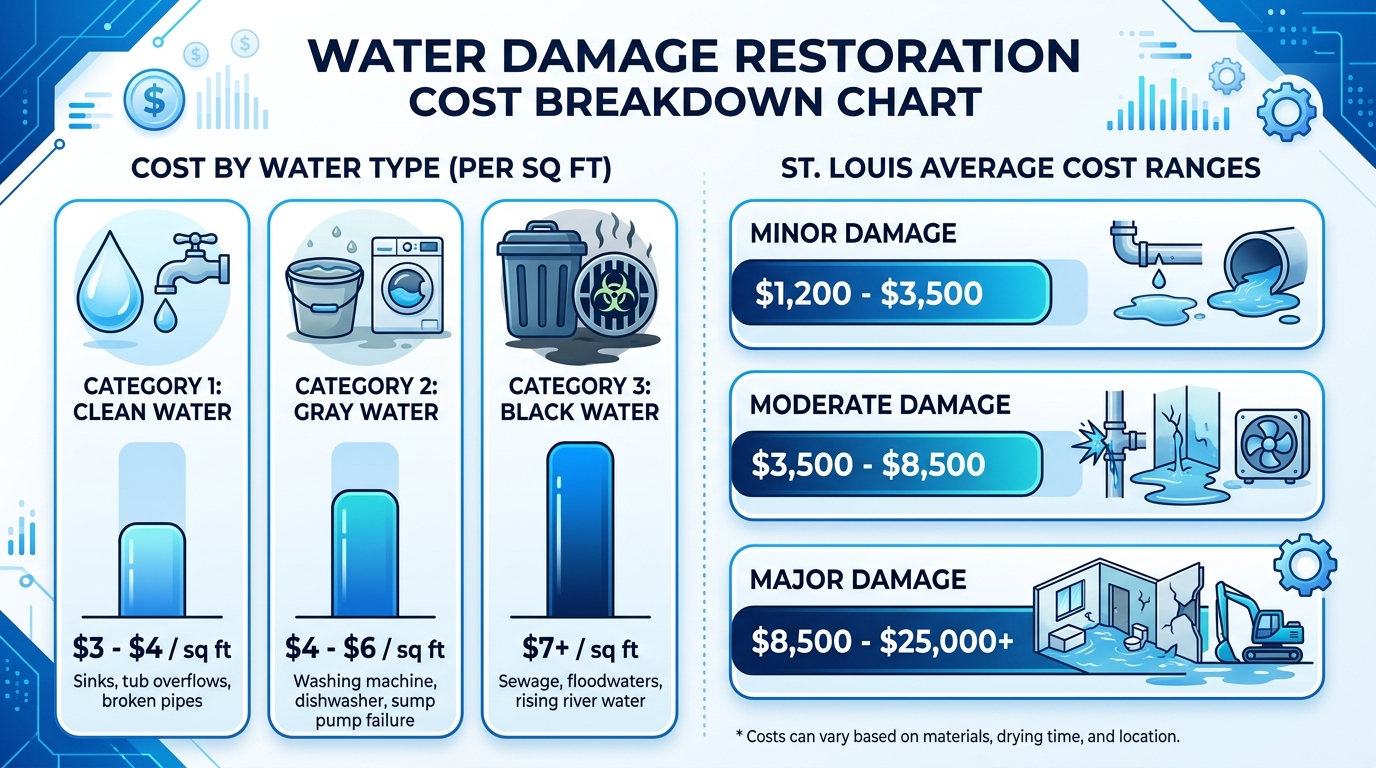
Compare itemized scopes and assumptions. Price alone does not establish whether the work is adequate.
Primary Cost Drivers:
Category of Water (Cleanliness):
- Water source and contamination: Have actual conditions assessed before selecting cleanup methods or estimating costs.
- Appliance or sump-related water: The named source alone does not establish contamination category or price.
- Sewage or floodwater: Ask a qualified provider about the actual cleanup scope and itemized cost.
Extent of Damage:
- Square footage affected
- Number of floors involved
- Affected materials and whether repair or replacement is appropriate
- Whether walls/ceilings require opening for drying
St. Louis-Specific Factors:
- Basement scope: finished materials and contents can change the required restoration work; compare itemized estimates for the actual loss.
- Historic materials: Ask whether the provider has relevant experience with the actual assembly and preservation requirements.
- Mold prevention: repair the moisture source and dry affected materials; antimicrobial use should follow the inspected scope and product label.
Pricing Transparency:
Reputable companies provide line-item estimates showing:
- Equipment rental fees per day
- Labor hours at standard rates
- Material costs (antimicrobials, containment materials)
- Emergency service surcharges (if applicable)
Request Property-Specific Itemized Quotes:
- Single-room damage: Obtain a quote based on actual affected materials.
- Multiple-room damage: Compare the proposed scope and assumptions.
- Extensive damage: Confirm access, safety, material and reconstruction requirements.
Compare the work proposed and ask about omissions. No unsupported local price range establishes whether a contractor cuts corners.
How do I evaluate reviews and avoid restoration company scams?
Verify business details, references and written terms before authorizing work. These checks do not guarantee protection from poor performance.
Review Evaluation Strategy:
Check Multiple Platforms:
- Google Reviews: Read relevant recent accounts and verify details where possible.
- Better Business Bureau (BBB) rating and complaint history
- Yelp (local perspective)
- Industry-specific: Angi, HomeAdvisor
What to Look For:
- Response to negative reviews: Professional companies address complaints and attempt resolution
- Detailed positive reviews: Generic reviews are less valuable than detailed accounts of the restoration process
- Platform differences: Review the underlying accounts; a rating difference alone does not prove manipulation.
- Review dates: Ask about current ownership and staff directly; a gap in reviews does not establish a change.
Red Flags and Scams to Avoid:
Storm Chasers:
Verify the actual firm’s identity, current contact details, applicable credentials and references. An out-of-town address alone does not establish poor work or fraud.
Assignment of Benefits (AOB) Abuse:
Understand any assignment of benefits or other contract terms before signing; seek qualified advice about their effect on your specific claim and obligations.
High-Pressure Tactics:
Ask for written terms and time to understand them. Verify any statement about claim deadlines directly with the insurer.
Verification Steps:
- Verify the credentials and business requirements applicable to the actual jurisdiction and scope.
- Confirm physical address exists via Google Street View
- Ask for local references from recent jobs
- Check if they belong to industry associations like the Restoration Industry Association (RIA)
What should I expect during the water damage restoration process?
Ask the provider to explain the proposed stages and documentation for your actual loss. A generic checklist does not certify adequate work.
Stages to Discuss for the Actual Scope:
Emergency Response: Confirm Current Availability
- Initial assessment and safety inspection
- Water extraction and removal of standing water
- Moisture detection to determine extent
- Content manipulation (moving furniture, removing items)
- Initial equipment placement
Drying Phase: Follow Measured Progress
- Daily moisture readings and equipment adjustments
- Any treatment selected for actual conditions and applicable product instructions
- Controlled demolition if walls/ceilings require drying access
- Content pack-out and cleaning (if required)
Verification: Assess Actual Completion Criteria
- Material-specific assessment and completion documentation
- Interpretation of any thermal observations alongside other findings
- Documentation for insurance
- Equipment removal
Reconstruction: Confirm Readiness and Scope
- Replacement of drywall, flooring, trim
- Painting and finishing
- Final inspection
Your Role as Homeowner:
- Provide access for daily monitoring (or arrange key access)
- Communicate any concerns about drying progress
- Approve any necessary demolition beyond initial scope
- Review documentation for insurance submission
Ask how the contractor will document progress and determine readiness for reconstruction. No universal instrument reading or process guarantees adequate drying.
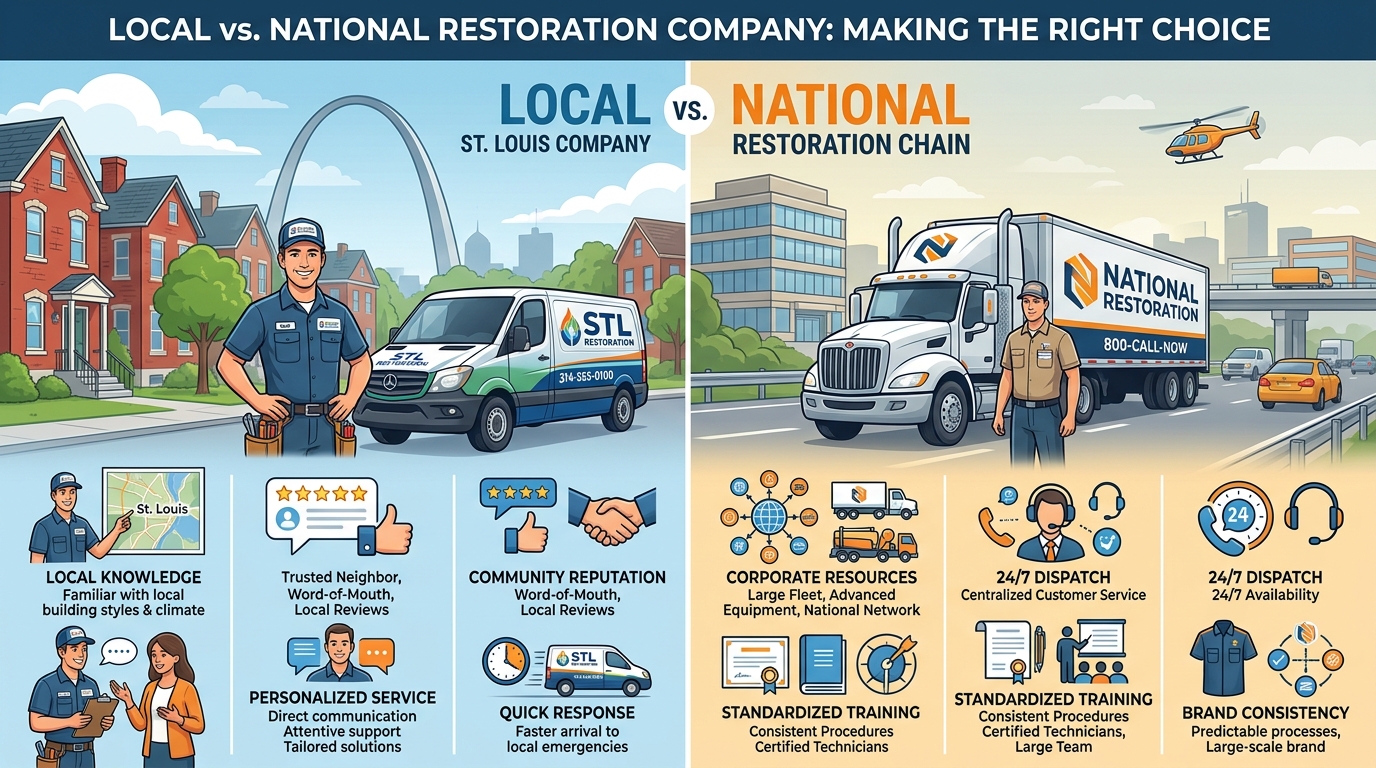
Should I choose a local St. Louis company or a national restoration chain?
Both local and national restoration companies operate in the St. Louis market. Each has advantages depending on your situation.
Local St. Louis Restoration Companies:
Advantages:
- Applicable requirements: Ask how the provider will confirm the rules for the actual jurisdiction.
- Established local reputation: Word-of-mouth accountability in the community
- Knowledge of local hazards: Understanding of Mississippi River flood patterns, common St. Louis home construction types, and regional insurance practices
- Owner involvement: Confirm who will supervise and communicate about the work.
Considerations:
- May have smaller equipment inventories for catastrophic events
- Variable service quality depending on the specific company
National Restoration Chains:
Advantages:
- Capacity: Confirm resources actually available for your loss.
- Training and equipment: Verify the specific branch and crew’s qualifications.
- Insurance relationships: Verify any claimed network enrollment or affiliation directly.
Considerations:
- Franchise operations may vary in quality
- Service scope: Confirm which options the particular provider can offer.
- Pricing: Compare itemized quotes rather than assuming an overhead premium.
- May use out-of-area contractors during busy periods
The St. Louis Market Context:
Ask about experience with the actual building materials and loss. Regional soil assumptions do not establish a contractor’s competence.
Compare providers on verified credentials, actual capacity, scope, references and written terms. No local-versus-national category alone establishes the best choice or an insurer-required vendor.
Frequently Asked Questions About Choosing a Water Damage Restoration Company
How long does water damage restoration take?
Drying and reconstruction duration depend on actual conditions and scope. No universal local timeline or seasonal extension is established here.
Can I stay in my home during water damage restoration?
Have appropriate professionals assess safe occupancy for the actual conditions. A water category or room count alone does not determine whether staying is safe. Ask about safe occupancy during any mold remediation.
Does homeowner’s insurance cover water damage restoration?
Ask your insurer about the actual cause, policy, exclusions and any flood coverage. No general coverage result or required insurance provider is established here.
How do I prevent mold after water damage?
Address wet materials promptly and have the actual condition assessed. No fixed deadline or routine chemical treatment guarantees mold prevention.
What should I do immediately after discovering water damage?
Keep clear of standing water and wet electrical equipment. Stop the source only if safe, arrange qualified help and photograph visible damage from a safe location.
Why is my restoration company recommending demolition?
Ask why removal is proposed and what findings support it. No inspection method guarantees that only the minimum material will be removed or every concealed area identified.
How do I know if the restoration company is drying properly?
Ask for documented moisture readings and the basis for drying goals. Meter scale, material type and suitable comparison areas matter; do not apply one percentage across wood, drywall and concrete or treat thermal imaging alone as proof of dryness.
What makes Gateway Water & Mold different from other St. Louis restoration companies?
Gateway provides water damage restoration services and moisture assessment. Confirm current response availability, credentials, equipment, billing and documentation for the actual work; no universal every-job process or payment arrangement is established here.
Get Professional Water Damage Restoration in St. Louis
Contact Gateway about the actual restoration scope and current availability. No blanket claim of meeting every criterion or protecting health is established here.
Use Gateway’s current published contact details to request help and confirm assessment scope, charges and response availability.
Our St. Louis Service Area Includes: St. Louis City and County, Florissant, Ballwin, Chesterfield, Kirkwood, Webster Groves, Maplewood, Richmond Heights, Clayton, University City, Maryland Heights, Hazelwood, Affton, Mehlville, Oakville, and surrounding communities.
Contact Gateway about observed water damage and assessment of the actual materials and source.
Related: Mold remediation services | Sewage cleanup | Emergency water damage response
Sources (reviewed 2026-09-10): www.epa.gov.
Sources (reviewed 2026-09-10): www.cdc.gov.