
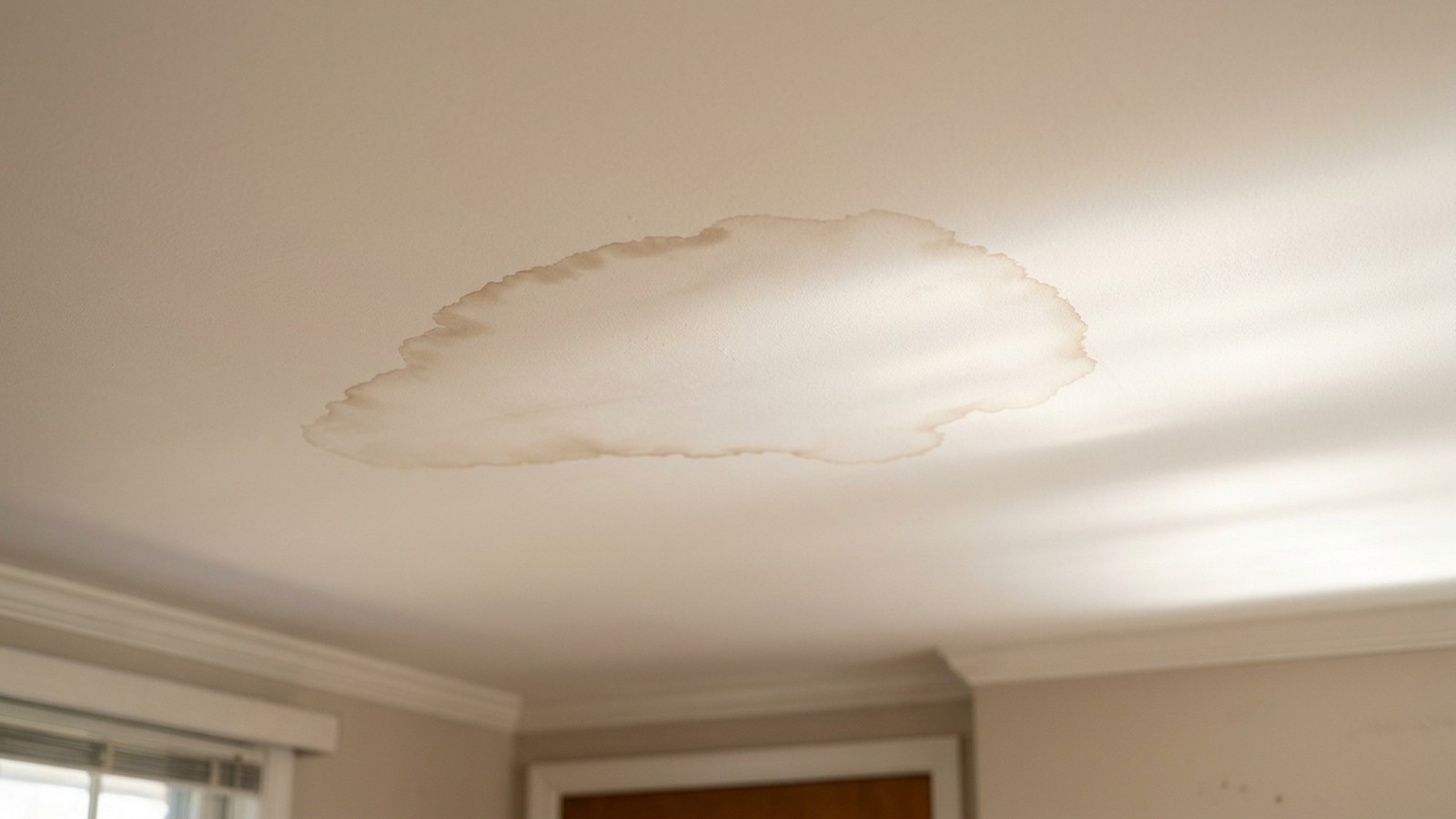
A brown water stain on a ceiling means water has already passed through the assembly above it and carried dissolved minerals, dust and wood tannins to the surface. The stain is the residue left behind after the water evaporated, not the water itself. The useful question is not what the stain is. It is whether the leak that made it has stopped.
This guide covers how to read a ceiling stain: what the shape and color tell you, how to tell an active leak from a dried-out old one, which ceilings need to be cleared underneath immediately, and why painting over a stain without finding the source is the most expensive shortcut in the house.
Is a water stain on the ceiling serious?
Sometimes, and the severity depends entirely on whether water is still arriving. A single crisp ring from a decade-old overflow above a bathroom is a cosmetic problem. A soft, spreading, actively damp patch is a structural and safety problem, because the material holding the ceiling up is holding water too.
Sort it by what you can observe:
| What you see | What it usually indicates | What to do |
|---|---|---|
| Dry, crisp-edged brown ring that has not changed | An old, resolved leak | Verify it is dry, then seal and repaint |
| Stain that is larger than it was last month | Active or intermittent leak | Find the source before any cosmetic work |
| Damp or cool to the touch | Water is present now | Clear the area below and get it assessed |
| Ceiling sagging, bulging or bellied downward | Water is pooling above the drywall | Leave the area immediately; do not stand under it |
| Paint bubbling or tape seams lifting | Saturated drywall or joint compound | Treat as active until proven otherwise |
| Fuzzy or discolored growth at the stain edge | Moisture has been present long enough for mold | Do not disturb it; get it assessed |
| Stain near a light fixture or ceiling fan | Water and an electrical device in the same assembly | Switch that circuit off at the panel |
The sagging case is the one that hurts people. Wet drywall holds a surprising amount of water and gives way all at once rather than gradually. If a ceiling is bellied, get everything and everyone out from under it and treat it as a load waiting to drop.
How can you tell if a ceiling leak is still active?
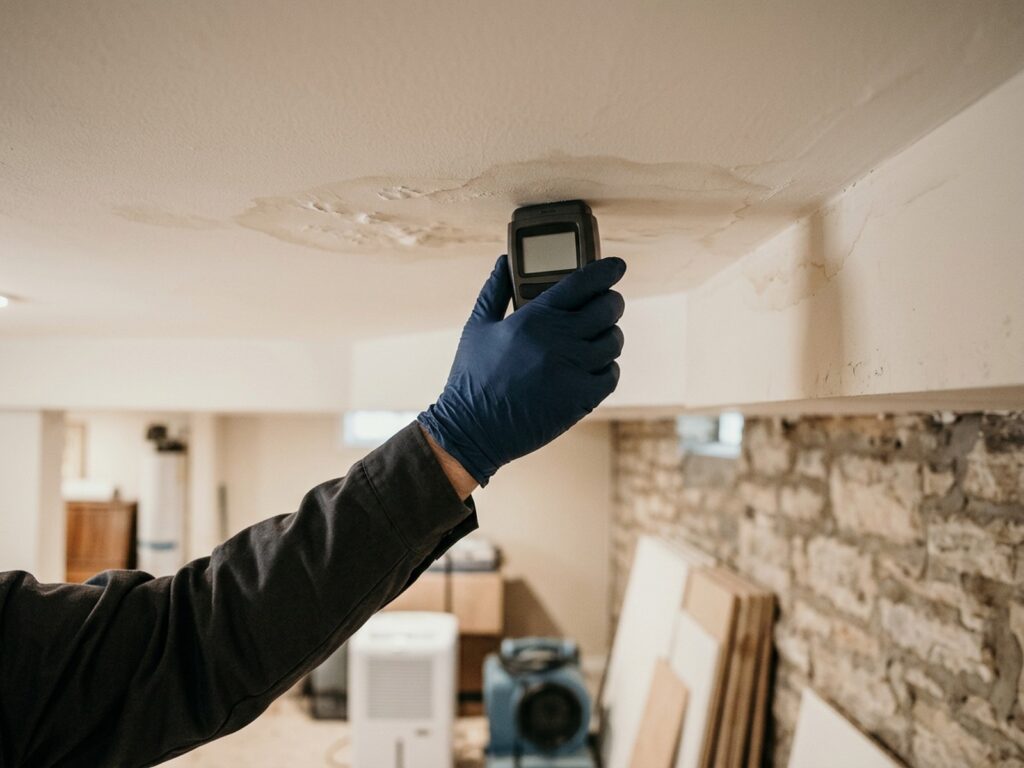
Dry the stain’s surroundings, mark it, and watch it. An old stain does not change and an active one does. Three checks separate them without opening anything up.
Mark the boundary. Trace the outer edge of the stain lightly in pencil and write the date next to it. Check it after the next heavy rain and again a week later. Growth past the pencil line means water is still arriving.
Feel it, carefully. An active stain is cooler and softer than the ceiling around it. Press gently at the edge with a fingertip rather than the middle, and never press on anything that looks bellied.
Time it against weather and use. If the stain darkens only after rain, the source is outside: roof, flashing, a wall penetration, a gutter overflowing back under the edge of the roof. If it darkens after somebody showers or runs a washing machine, the source is plumbing. If it changes with neither, look at HVAC condensate lines and ductwork, which sweat in humid weather and drip inside ceilings all summer.
Our water damage timeline guide walks through what happens hour by hour once water is in a building assembly, and it is a useful reference for judging how long a slow ceiling leak has probably been running.
What causes a brown stain on a ceiling?
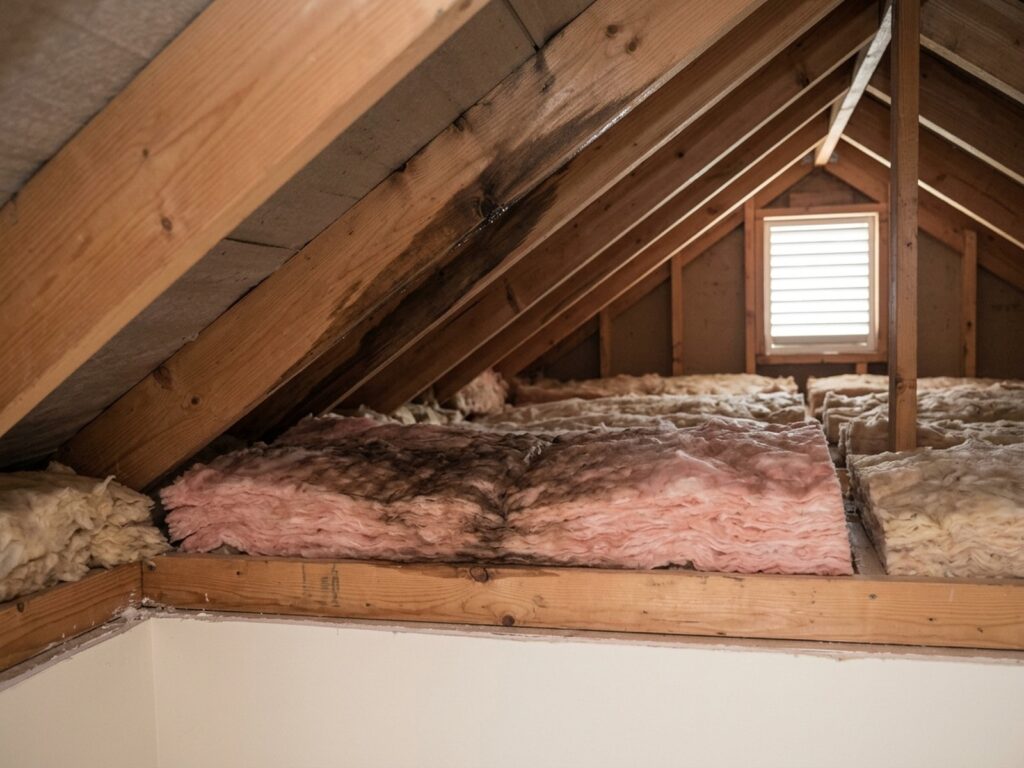
Water from one of four systems, and the room above the stain narrows it quickly. The brown color comes from what the water picked up on the way: dust in the cavity, tannins from framing lumber, corrosion from a metal fitting, or minerals from the water supply itself.
- Roof and flashing. The most common cause in older St. Louis housing stock. Failed flashing at a chimney, a valley, a vent boot or a wall junction lets water in during wind-driven rain, and it can travel along rafters for several feet before dropping.
- Plumbing above. A supply line, a drain, a toilet flange seal, or a shower pan. Supply leaks are steady regardless of weather; drain leaks only appear when the fixture is used.
- HVAC condensate. An air handler in an attic or a condensate drain running through a ceiling. Clogged condensate lines produce a stain that appears in humid weather and stops in cool weather, which fools people into thinking it resolved.
- Ice dams and winter freeze damage. Melt water backing up under shingles at the eaves, or a pipe in an unconditioned space that split and is leaking only when the line is pressurized.
There is a fifth case worth knowing: condensation without a leak at all. A poorly ventilated attic over a well-insulated ceiling can accumulate enough moisture on the underside of the roof deck to drip onto the ceiling below. It looks exactly like a roof leak and is fixed completely differently.
Can you just paint over a water stain?
Only after the source is fixed and the material behind it is dry, and even then the stain needs sealing first or it bleeds back through. Painting an active stain hides the evidence while the assembly keeps getting wetter, which is how a repair that would have been a patch becomes a section of ceiling.
Before any cosmetic work, three things have to be true:
- The source is identified and repaired. Not suspected. Repaired.
- The cavity is dry, measured rather than guessed. Drywall can feel dry on the painted face while the insulation and framing above it are still wet. A moisture meter answers this; a hand does not.
- Nothing porous above it is still saturated. Wet blown-in insulation stays wet for a very long time and keeps re-wetting the drywall below it.
That last point is where the mold risk lives. EPA guidance is to clean and dry any damp or wet building materials and furnishings within 24–48 hours to prevent mold growth, and a ceiling cavity that has been damp for weeks is far outside that window. EPA also notes that absorbent or porous materials, such as ceiling tiles and carpet, may have to be thrown away if they become moldy, which is the honest answer for a saturated ceiling tile or a wet batt of insulation.
Our page on whether water-damaged drywall can be saved covers how that decision gets made on a wall or ceiling that has actually been wet.
What should you do right now if the ceiling is actively leaking?
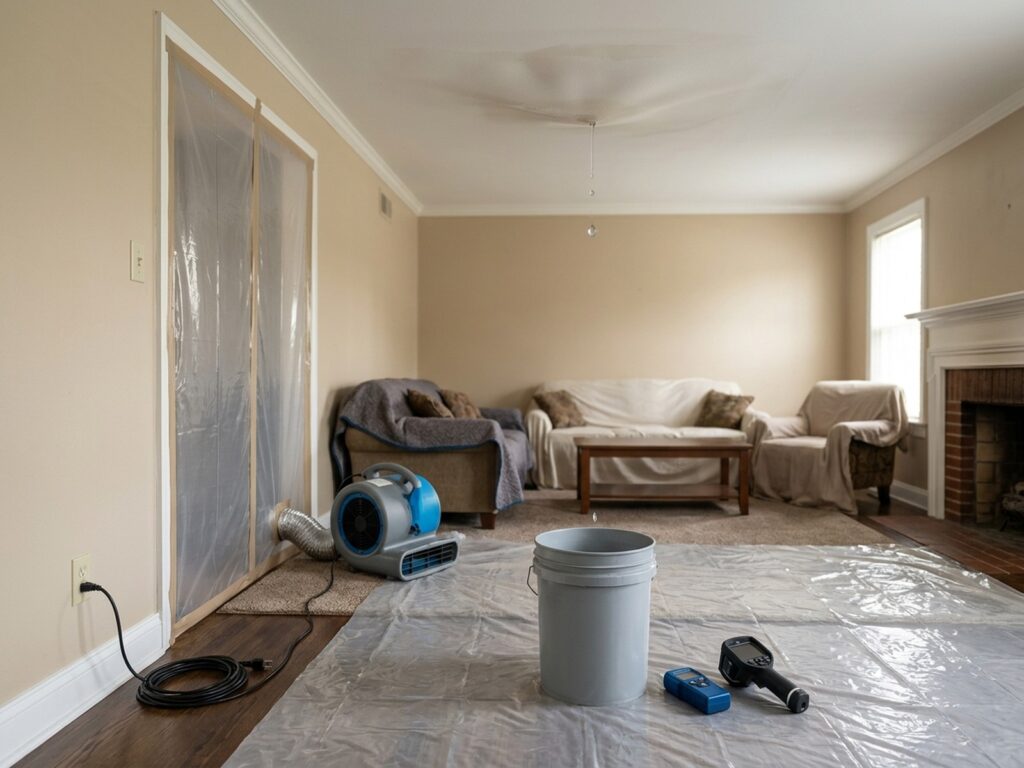
Protect the space below, relieve the water load, and stop guessing about electricity. In that order.
- Move everything out from under it. Furniture, electronics, rugs. Lay down a tarp or a plastic sheet and put a container under the drip.
- Switch off the circuit for any light fixture, fan or smoke alarm in or near the wet area. Do not operate a fixture that has water around it.
- Relieve a bulge deliberately rather than waiting for it to fail. A small hole punched at the lowest point of a belly, with a bucket underneath, drains the pool in a controlled way instead of dropping a sheet of wet drywall on the floor. Only do this if you can do it safely from the side, never from underneath.
- Contain the source if you can reach it. A shutoff valve for the fixture above, or a tarp over the roof section if conditions allow it safely. Do not go on a wet or steep roof.
- Photograph it. Before you move anything and again after: the ceiling, the room, the contents, and the room above.
- Note the timing. When you first saw it, what the weather was doing, what fixtures were in use. That detail shortens the diagnosis considerably.
When should you call a restoration contractor instead of a handyman?
When water has been inside the assembly long enough that the question is moisture, not patching. A handyman or roofer fixes the source. A restoration contractor deals with what the water did on the way through, and those are two different jobs that often both need doing.
Call for a restoration assessment when any of these apply: the ceiling has been wet more than a couple of days, insulation above it got wet, the stain covers a broad area, there is a musty smell in the room, growth is visible, the water came from a drain rather than a supply line, or you are planning to involve your insurer. Moisture mapping and thermal imaging find the extent of a ceiling loss without opening the whole ceiling, which usually means less demolition, not more.
Frequently asked questions
Does a water stain on the ceiling always mean there is a leak now?
No. A dry, stable, crisp-edged stain is the residue of a leak that has already stopped. What tells you it is current is change: a growing edge, dampness, softness, bubbling paint or a sag.
Can a ceiling stain be mold?
The stain itself is mineral and tannin residue, not mold, but mold can grow at the same spot because the conditions that made the stain also support growth. Fuzzy texture, black or green speckling, or a musty smell in the room all point that way, and EPA advises fixing the moisture source first because mold will grow where moisture is present.
How long does it take for a ceiling to dry after a leak?
Longer than the surface suggests. Painted drywall can feel dry within a day while the insulation and framing above it hold moisture for weeks. Drying is finished when meter readings match unaffected areas, not when the ceiling looks normal.
Is a sagging ceiling dangerous?
Yes. A belly means water is pooling above the drywall, and saturated drywall fails suddenly rather than gradually. Clear the area underneath and keep people out of it until the water is drained and the material is assessed.
Why did my ceiling stain come back after I painted it?
Either the source was never fixed, or the stain was painted without a stain-blocking primer and the residue bled through. A returning stain that spreads is the first case; one that reappears at exactly the original size is usually the second.
Should I file an insurance claim for a ceiling leak?
That depends on your policy, the cause, and how long the leak ran, and your carrier makes that call rather than a contractor. Document it thoroughly first. Our guide to what to document before filing a water damage claim covers what to capture before anything is moved.
Find out what is above the stain
If a ceiling stain is growing, damp or sagging, the next step is finding how far the water actually travelled inside the assembly, which is a measurement, not a guess. Gateway Water & Mold provides water damage restoration and moisture assessment across the St. Louis metro in Missouri and Illinois.
Call (314) 947-3419 to have it looked at before the cosmetic repair.